


'Blame the Bankers!' ...Should We?
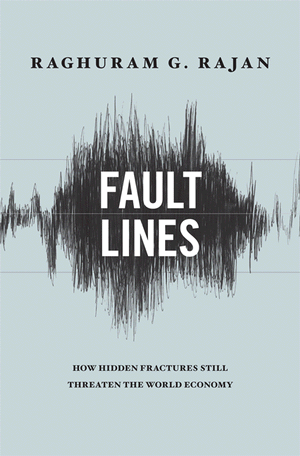
This is a convenient explanation for many; it provides an easily-identifiable group to blame, despise and reform.
However, although they definitely can be blamed to an extent, are 'Bankers' totally to blame for the global economic crisis from which the world is slowly crawling?
'Fault Lines' is a critically acclaimed book by a leading economist, Raghuram Rajan, who argues that serious flaws in the economy are also to blame, and warns that a potentially more devastating crisis awaits us if they aren't fixed.
Raghuram Rajan was one of the few economists who warned of the global financial crisis before it hit, and the alternative explanations offered, including income inequality, global trade imbalances and flawed financial incentives to name but a few, are explored with confidence and panache: 'Fault Lines' is a fascinating read.
Read a small preview here. Enjoy.
How Up-to-Date Are You?
Economics News Quiz 24 January 2011
Take a look at the above 'Economics in the News Quiz' for the past week - useful knowledge for exams, life or just fun! (Not to sound geeky at all!)
A Competitive NHS: Fairer, Fitter, Faster?
 |
| Cancer Bed Days by Primary Care Trust (The darker the blue the better [fewer days]) |
The main objective of the plan is to restructure the NHS, shifting the weight of power and decision-making from 'Whitehall bureaucrats' to the GPs on the front-line. This is intended to improve the efficiency of resource allocation for each region, as spending decisions will be made much closer to each locality, hopefully increasing the information and understanding on hand when these decisions are made, and hence the success of these decisions. Furthermore, this benefit is intended to occur whilst competition is increasing between smaller decision-making authorities, as patients will be allowed the freedom to choose where they receive treatment, and rationally, will choose the best option available to them. Such competitive pressures are intended to increase equality and improve equity across the country. How?
In classical economic theory, the ideal allocation of healthcare is at a quantity where a 'Pareto optimum' allocation is created. This means that welfare of all individuals linked into the market for healthcare is maximised, and more welfare cannot be given to another patient without directly decreasing the welfare of another. Such an output is said to be an 'allocatively efficient' one; resources are being allocated in a way which is maximising the welfare of all, internal and external to the market - hence it is an efficient allocation of resources.
Competition creates the basis for this to happen for a number of reasons. Many small service providers, all with the same ability to provide an equal service, and the freedom of consumers to switch to the service-provider who will provide them with the best quality service with least risk, will create a strong incentive for hospitals and GPs to increase the quality of their healthcare - if they don't, they will be left without patients and their weaknesses will be exposed.
Furthermore, competition may act to drive down costs in the long-run, after the initial 'bedding-in' costs of the new scheme; especially important to meet surging demand and costs from ageing population and technological change in this time of global austerity. This decrease in costs may be caused by increased competitive pressure to minimise costs - the service providers with the lowest costs will be able to use that saved money elsewhere, to improve the quality of the service, thus gaining a competitive advantage, important in a competitive health system.
However, will such a system be fair?
Not necessarily, without a very stringent operating framework, there could be a strong incentive to discriminate against the weakest or higher-cost patients to get unnecessary costs off the books.
Furthermore, how do inexperienced doctors decide how to spend money? Pay expensive administration and consultancy staff, that's how! Hence, it is possible that the transfer of power from Whitehall to smaller localities could simply transfer costs too, from the public to the private sector.
And, will the reforms create real competition between providers on quality? In reality, patients may not switch to slightly better health-care providers if they value the convenience of the service over the small differentials in the quality. Hence, this could cause competition to only really be effective in small areas of similar health-care providers, once again creating differences in quality across regions: back to square one.
As is being said often across professions and politics, these reforms are a big risk. Will they create real competition, or just conditions for competition to take place, without it actually happening as planned? Will they lead to increased differentials in the NHS for different people and different regions? We wait and see....
Fairtrade: A Future Fair for All?

On average, the quantity of 'Fairtrade' goods being traded in the UK has been doubling every 2 years. At least 20% of Bananas, Coffee and Chocolate sold in the UK are sourced from Fairtrade suppliers. And 7 million farmers in 58 countries globally benefit directly from the Fairtrade movement. However in economics it is rare for any form of market intervention, or on the other hand any abstinence from it, to be without its doubters.
The underlying problem that generates a case for Fairtrade setting a market price-floor, is that many firms have near-monopsony power over farmers, let’s use cocoa farmers as an example. This means that they possess a lot of bargaining power when negotiating prices for the cocoa they need to create their own chocolate with, as they are the only, or a very valued and significant customer for, the cocoa-farmer. Therefore, they are able to drive the price of the cocoa down beneath a free-market equilibrium, as the farmer essentially is a price-taker and has no power to ignore and rebuff unfair prices under the equilibrium price which they need to be fully satisfied, and would ideally only supply at (i.e. normal profits).
However Fairtrade artificially tries to eradicate this power imbalance, through setting a price floor on the market, as shown above using a supply and demand diagram.
This has the effect of creating excess supply in the Fairtrade markets, as the market is no longer in its free-market equilibrium. This excess supply may subsequently harm those markets that are not Fairtrade, reducing their demand and revenue; assuming that not all firms in the intervened market are under the shield of Fairtrade. Hence, those who are with Fairtrade benefit, but at the price of hurting those not aligned with Fairtrade, which may cause a less even distribution of income in such emerging economies on aggregate, which could be seen as unfair and inequitable.
However, price distortion is by no means definite. One counterargument against price distortion could be because this argument does not take into account the principles of product differentiation. Coffee, for example, cannot be compared to other commodities such as oil: there is not one single type of coffee but instead many different coffees that are differentiated from one another in terms of production techniques, seasonal or regional differences in quality, blending, packaging, handling, and now also "social responsibility". Therefore it could be that the market equilibrium for Fairtrade goods, which are perceived to be equal to the price of non-Fairtrade good + a social responsibility value by consumers, lie at a higher price-level, as consumers will pay more based on environmental and social responsibility claims. Hence although the price of Fairtrade goods may be higher, it is so because that is the markets natural equilibrium, and therefore excess supply does not necessarily exist.
Whatever the case, Fairtrade is a movement which is growing, evolving and encompassing food markets in particular. According to research by the Fairtrade foundation, 65% of consumers recognise and understand what Fairtrade is about, and are supportive of it. If they support it and understand it, it is likely that they will differentiate Fairtrade goods from others. However, will they buy both Fairtrade and non-Fairtrade products? That is unlikely. Therefore, as Fairtrade gains popularity, there must be a proportionate increase in the number of Fairtrade suppliers involved with it, otherwise the danger could be of crippling non-Fairtrade markets, not necessarily through ‘unfair’ prices, but through a simple lack of demand.
However Fairtrade artificially tries to eradicate this power imbalance, through setting a price floor on the market, as shown above using a supply and demand diagram.
This has the effect of creating excess supply in the Fairtrade markets, as the market is no longer in its free-market equilibrium. This excess supply may subsequently harm those markets that are not Fairtrade, reducing their demand and revenue; assuming that not all firms in the intervened market are under the shield of Fairtrade. Hence, those who are with Fairtrade benefit, but at the price of hurting those not aligned with Fairtrade, which may cause a less even distribution of income in such emerging economies on aggregate, which could be seen as unfair and inequitable.
However, price distortion is by no means definite. One counterargument against price distortion could be because this argument does not take into account the principles of product differentiation. Coffee, for example, cannot be compared to other commodities such as oil: there is not one single type of coffee but instead many different coffees that are differentiated from one another in terms of production techniques, seasonal or regional differences in quality, blending, packaging, handling, and now also "social responsibility". Therefore it could be that the market equilibrium for Fairtrade goods, which are perceived to be equal to the price of non-Fairtrade good + a social responsibility value by consumers, lie at a higher price-level, as consumers will pay more based on environmental and social responsibility claims. Hence although the price of Fairtrade goods may be higher, it is so because that is the markets natural equilibrium, and therefore excess supply does not necessarily exist.
Whatever the case, Fairtrade is a movement which is growing, evolving and encompassing food markets in particular. According to research by the Fairtrade foundation, 65% of consumers recognise and understand what Fairtrade is about, and are supportive of it. If they support it and understand it, it is likely that they will differentiate Fairtrade goods from others. However, will they buy both Fairtrade and non-Fairtrade products? That is unlikely. Therefore, as Fairtrade gains popularity, there must be a proportionate increase in the number of Fairtrade suppliers involved with it, otherwise the danger could be of crippling non-Fairtrade markets, not necessarily through ‘unfair’ prices, but through a simple lack of demand.
Fancy Working Until You're 66?

Undoubtedly, a rise in the state retirement age is not, and certainly will not prove to be, one of the most popular moves of the Spending cuts in the UK. However, can it be justified?
Almost certainly.
Demograhic trends are set to experience seismic shifts as baby-boomers (people born between 1946 and 1964) retire over the next two decades. The consequent rise in older Adults will add huge amounts of stress not only to the already sizeable pension burden, but also to the NHS and infrastructure costs, as more long-term care (ie. Nursing Homes) facilities will need to be created to cope with surging demand as people live longer lives.
It really is a serious concern for current Governments. In fact, six European economies - Germany, France, Ukraine, Belgium, Luxembourg and Greece estimate that by 2050, at least 30% of their spending will be dedicated to age-related expenditure. And for the rest of the advanced global economies, their median spend will be around 27% of their state income. Such huge proportions of spending are clearly unsustainable, so the case for reform is clear. But what reform exactly?
Well, a crude method could be to try and stop people from living longer, lingering, burdensome lives, but that's not ethical. One may try and generate a second 'baby-boom' to pay for the original boom, but that's not practical, marketable or easy to do. Tax raises could pay for it; but there's no chance in today's climate. An increase in Government Fiscal Deficits could be permitted, surely one could pay it off in the future; well, that would certainly contradict other current Government policies. Or, even easier, one could allow immigration to bump up the number of taxpayers in the country; again not easily marketable politically, particularly during a time of unemployment.
Hence, the only sensible option left it would seem, in this climate at least, is to raise the retirement age. As life expectancies increase steadily, it is generally viewed as reasonable to increase retirement ages at a similar rate. If this happens, the potential size of the workforce will grow, and so will it's potential to produce, pay taxes and enhance the long-run growth of the economy. There will of course be winners, those who just about qualify to retire early, and losers, especially the young, who would have filled the gaps of those who retired but now stay in employment for longer. However, in the long-run such unfairness caused by an increase is likely to be ironed out, i.e. when those who would have retired at 65 retire at 66 instead, the young will then be able to take the vacancies a year later than previously, restoring the young-old cycle as before, and then the positives really will outweigh the negatives.
In conclusion, raising the retirement age certainly will not be celebrated. It is simply a policy that will be hated less than its alternatives.
Don't Shoot the Messenger.
 |
| The Chancellor as he announces the results of the long-awaited spending review. |
In fact, in his speech Mr Osbourne did try to emphasise this message, and many of his other colleagues are now plugging the same party line: that they must 'confront the ghastly truth of Labour's legacy', as Liam Fox, Defence secretary, recently stated.
The simple graph below evidences the motives behind their campaign. The UK's deficit has ballooned recently, and at 10.1% of GDP in 2010, Britain has the largest budget deficit of any major economy globally. Only the United States comes close at 9.0%. However, why is this worrying, haven't we had budget deficits for years? We were fine then, right?
 |
| UK Fiscal Deficit as a percentage of GDP, including forecasted change in blue |
However on the other hand there are many who feel that cutting back too soon is sure to, or is is far too likely to, cause a double-dip recession, or in the 'best-worst case scenario' to introduce stagflation to the economy. Stagflation is a period when inflation and unemployment are rising simultaneously, but both growth and demand are stagnating. This happened in Japan in the 1990's, and thus far Japan does not seem to have recovered from the long-term drain that it has had on the technological power's productive potential. Included in this camp of opposers are of course the Labour party, who, living up to their newly-found title of 'The Opposition' are digging into some good opposing by arguing for a much slower and gentler rate of deficit-reduction.
However, could the real idealogical battle to arise from these spending cuts be one of Keynes Vs. Hayek? Government intervention and demand Vs. the free-market system and conservative beliefs? Some more cynical commentators see these spending cuts as a landmark change of direction for the UK, similar to that experienced during the period of Margaret Thatcher and Ronald Reagan, only this time with a more Keynesian slanted US President. The notion of shrinking the public sector, cutting around 490,000 jobs from it in a few years, and expecting, or even hoping that the Private sector will pick up the slack could be viewed as an attempt to increase the poignancy of the free-market in the UK, by increasing the size and role that the Private sector has in the economy. A marked reverse from the ever-expansionary approach of New Labour? Maybe.
We cannot yet tell if ulterior motives are paying a part in these spending cuts, it will become evident with time, and surely with hindsight.
All we can be sure of however is what the Government would like us to think concerning it's actions. Whilst delivering his announcement George Osbourne stated: 'A fair Government deals with the deficit decisevely'. Is that really true? Can the cuts really be considered to be fair?
Subscribe to:
Posts (Atom)